


- info@prototypeshlh.com
- +86-133-9285-9203
- Room 2003, 20th Floor, Xingji Building, Shangde Road, Shajing Street, Bao'an District, Shenzhen
SERVICES

CNC Machining Service
Tight tolerances and finishing capabilities, as fast as 2 days.

Vacuum Casting Service
Production quality parts without the tooling investment.

Sheet Metal Fabrication
Experience the versatility 6 cost efficiency withflexible application options.

Die Casting Service
Create high quality custom mechanicals withprecision and accuracy.

Injection Molding Service
Production-grade steel tooling, as fast as weeks.

Carbon Fiber Manufacturing
Composite materials, such as carbon fiber reinforced plastics are highly versatile and efficient materials.
Popular Services

Injection Molding Service
A faster, easier way to order high-quality injection molded parts that accelerates iteration, testing, and scaled production. Upload your designs for DFM feedback and pricing in 24 hours.

3D Printing Service
Our 3D printing solutions cater to personalised needs with a diverse range of materials and colour options, including SLA, SLS, FDM, Projet, DMLS, and MJF printing services.

Surface Finishing
The easiest way to source your custom parts, with 15+ surface finishing options.

Design Guide
In-depth design guides full of best practices for all of HLH's manufacturing processes.

Case Studies
Success stories from innovativecompanies using HLH.

Blog
lndustry trends, company news andproduct updates.
Featured Posts
3D Printing vs. CNC Machining: Which is Better for Prototyping?
View more →
The Advantages of Projection 3D Printing for Mass Production
View more →
How to Choose Between Aluminum Alloy Casting and CNC Machining
View more →
What is Vacuum Injection Molding? What Type Suitable for Production?
View more →

About Us
Learn about our company, leadership, and mission totransform manufacturing.

Privacy Policy
Applies to all personal information collected through and/or processed in connection.

Contact Us
Our team is on stand by, waiting to assist you.

Videos
A large collection of educational videos and tutorials.

Aerospace & UAV
HLH is your 3D manufacturing partner from prototype to large scale production.

Consumer Products
New Product Introduction Solutions for Consumer Products.

Automotive
New Product Introduction Solutions for Automotive.

Industrial Machinery
The main purpose of industrial prototyping is to take the product from drawings into the real world.

Robotics & Automation
Need some assistance bringing your robotic device or parts from the sketch-board to reality?

Medical Devices
The medical industry needs high quality, dependable and safe parts and products.

Communications
We understand the demands and ever changing landscape of the communications industry.

Product Development
Industrial design and engineering consultancies are some of the most innovate and creative enterprises on the planet.

From server racks and medical device chassis to automotive brackets and custom electronic enclosures, Sheet Metal Fabrication is one of the most versatile, durable, and cost-effective manufacturing methods available today.
Understanding how flat metal stock is transformed into complex 3D components allows engineers to optimize designs, cut material waste, and accelerate time-to-market. In this guide, we break down the step-by-step sheet metal process, essential design rules, material options, and post-processing treatments.
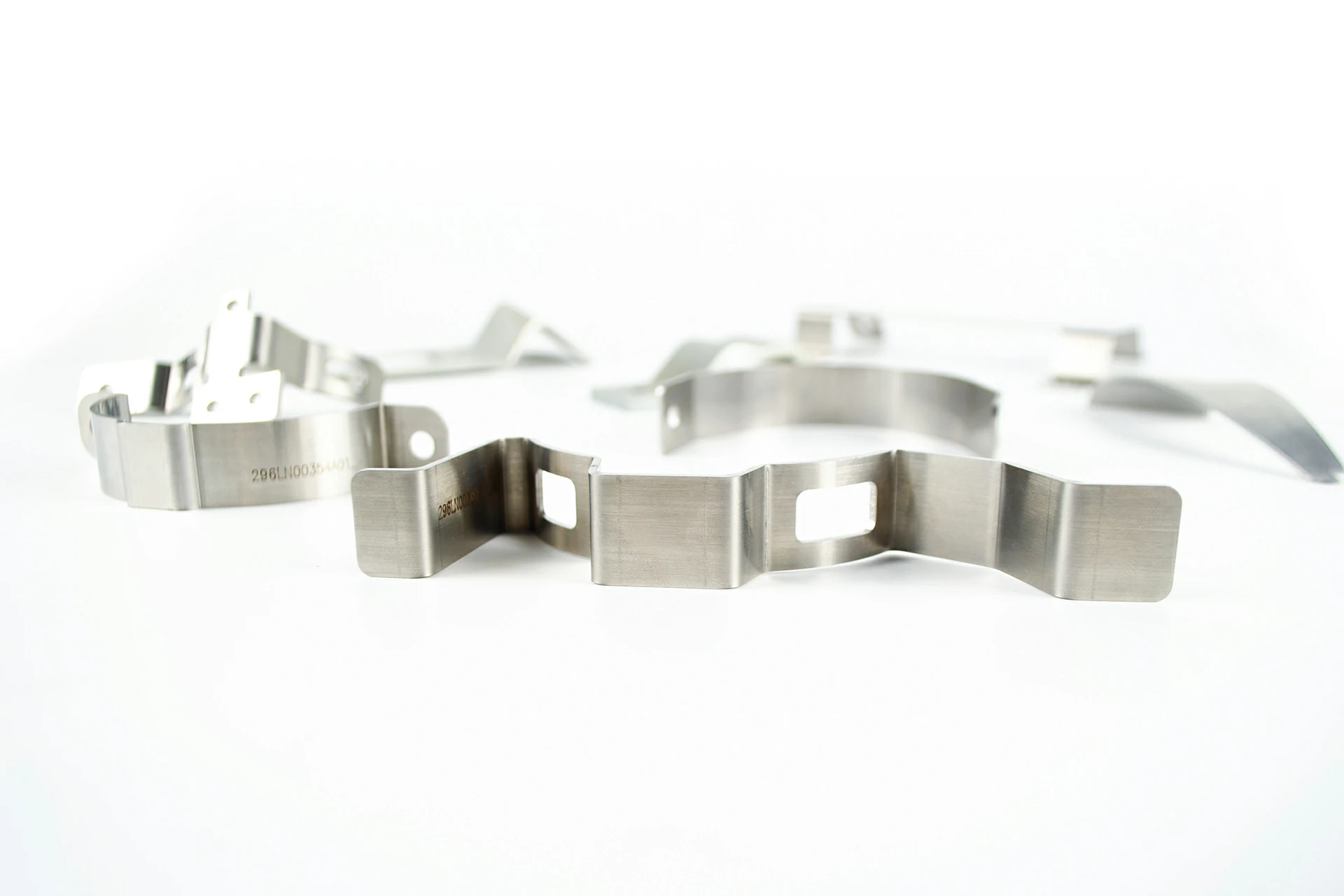
Sheet Metal Fabrication is a set of subtractive and formative manufacturing techniques that cut, bend, fold, and join thin flat sheets of metal (typically between $0.5\text{ mm}$ and $6.0\text{ mm}$ thick) into functional three-dimensional parts.
Because modern sheet metal processing uses automated CNC laser cutters, press brakes, and turret punches, parts can be fabricated directly from 3D CAD models without needing expensive hard tooling. This makes it ideal for both 1-off rapid prototypes and scalable production runs.
Fabricating custom sheet metal parts involves four core stages:
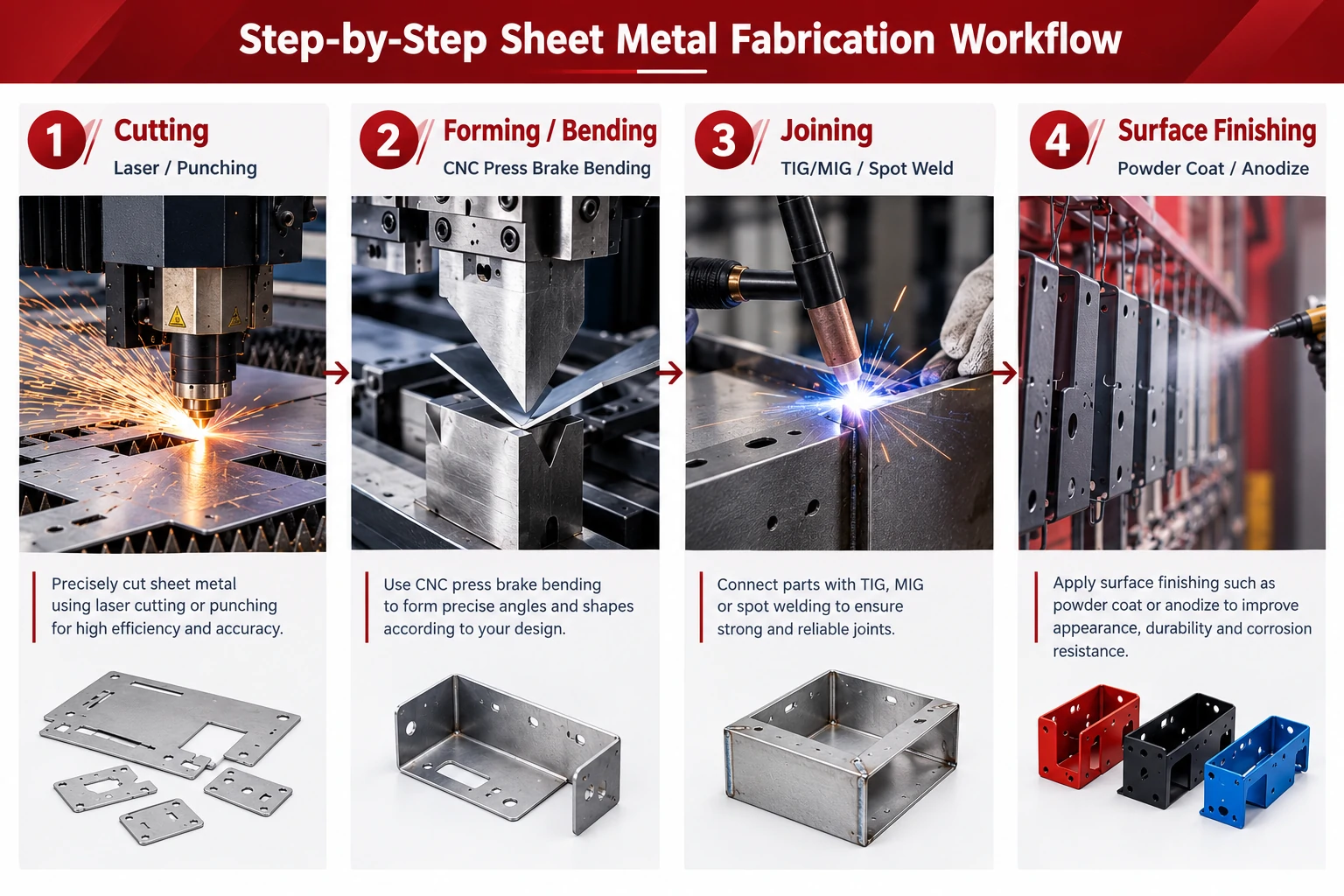
Laser Cutting: High-power fiber lasers slice through steel, aluminum, and brass with extreme accuracy ($\pm0.1\text{ mm}$), creating intricate profiles without mechanical force.
Waterjet Cutting: Uses high-pressure water mixed with abrasives to cut extra-thick metal sheets without creating heat-affected zones (HAZ).
CNC Punching: Ideal for high-speed creation of uniform holes, louvers, ribs, and knockouts.
CNC Press Brake Bending: Precision upper punches press the flat sheet into V-shaped dies beneath, creating clean bends along defined fold lines.
Rolling & Stamping: Used for cylindrical features, curved panels, or deep-drawn geometries.
Welding (TIG / MIG / Laser Welding): Fuses seams and corners together for structural rigidity.
Spot Welding & Riveting: Quick, reliable assembly for multi-layer sheet enclosures.
PEM Hardware Insertion: Installs threaded studs, nuts, and standoffs permanently into sheet metal panels for fast component mounting.
Powder Coating & Painting: Delivers high durability, corrosion resistance, and custom aesthetic colors (RAL/Pantone).
Anodizing (for Aluminum): Enhances wear resistance and offers decorative metallic finishes.
Passivation & Plating: Protects stainless steel, carbon steel, and copper against oxidation.
Material | Key Properties | Typical Applications |
Aluminum 5052 / 6061 | Lightweight, excellent corrosion resistance, easy to bend | Electronics enclosures, drone frames, bracketry |
Stainless Steel (304 / 316) | High tensile strength, heat resistant, superior corrosion protection | Medical enclosures, food-grade processing, marine hardware |
Cold-Rolled Steel (SPCC) | Highly ductile, smooth surface finish, cost-effective | Indoor electronic cabinets, appliance housings (requires painting) |
Copper & Brass | High electrical and thermal conductivity, non-magnetic | Busbars, EMI/RFI shielding, decorative hardware |
Adhering to key DFM guidelines ensures smooth bending and avoids material tearing:
Keep Uniform Wall Thickness: Always use a single sheet thickness across the entire design.
Bend Radius Rule: Set the inside bend radius equal to or greater than the material thickness ($R \ge t$) to prevent cracking along fold lines.
Hole Clearance from Bends: Keep hole edges at a minimum distance of $2\times t + R$ away from bend lines to avoid oval distortion during forming.
Bend Relief Slots: Add small relief cuts at the ends of bend lines where flanges meet flat surfaces to prevent tearing.
No Tooling Investment: Cut parts directly via CNC laser cutting without needing injection molds or custom dies.
High Strength-to-Weight Ratio: Thin metal walls provide structural rigidity while keeping overall assembly weight low.
Rapid Turnaround: Prototype sheet metal enclosures can be cut, folded, and powder-coated in as fast as 3 to 5 business days.
Whether you need a custom aluminum bracket prototype or a batch of 500 powder-coated stainless steel device enclosures, having a comprehensive rapid manufacturing partner makes all the difference.
At HLH Prototypes, our sheet metal shop combines fiber laser cutting, CNC press brake forming, automated hardware insertion, precision welding, and in-house surface finishing:
Complete On-Demand Manufacturing: Combine sheet metal with CNC Machining, SLA/SLS 3D Printing, Vacuum Casting, Rapid Injection Molding, and Carbon Fiber Manufacturing.
Expert DFM Review: Free sheet metal bend and relief analysis before cutting begins.
ISO Quality Assurance: ISO 9001 certified with CMM dimensional checks, powder coat thickness testing, and material certification reports.
Need high-precision sheet metal parts fabricated fast? Upload your 3D CAD files to HLH Prototypes today for an instant quote and expert DFM analysis.
SERVICES